Introduction: What is Diastasis Recti?
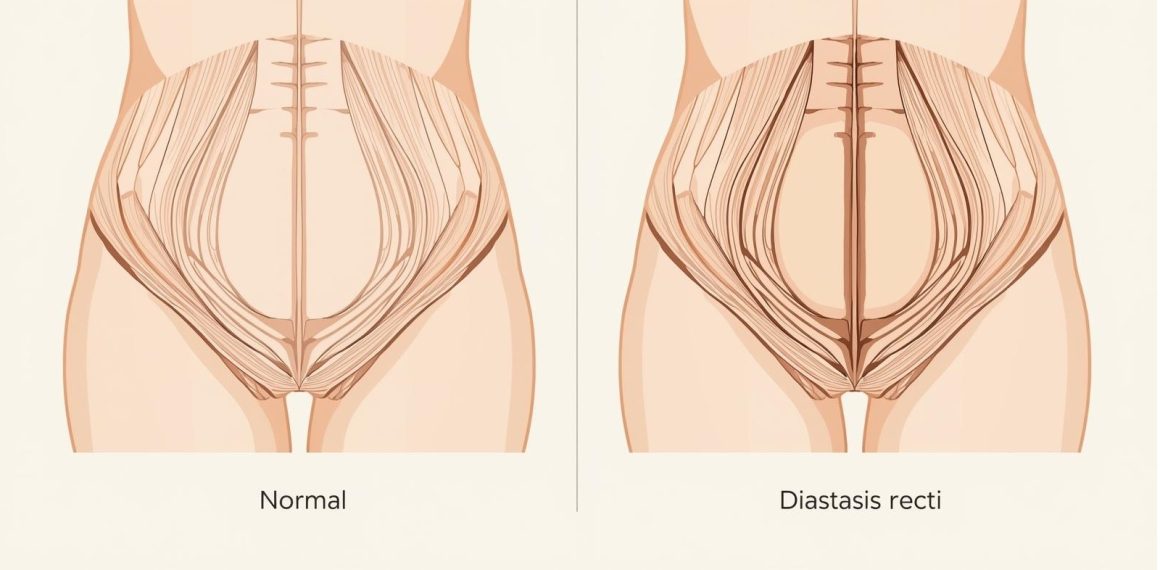
If you just had a baby, you might notice something strange – your belly feels weak, or there’s a gap or bulge down the middle of your stomach. This is called diastasis recti (pronounced “dee-AHS-tuh-sis REK-tee”).
Sounds scary? However, it’s not!
Diastasis recti simply means your abdominal muscles (belly muscles) have separated. According to the National Institutes of Health, this happens to almost 60% of pregnant women. During pregnancy, your growing baby pushes your muscles apart, and after delivery, they don’t always come back together right away.
The good news? Specific diastasis recti exercises can help your belly muscles come back together.
In this guide, you’ll learn:
- Why this happens
- How to check if you have it
- Safe exercises to fix it
- When to see a doctor
Let’s get started.
Why Does This Happen?
Your belly has two big muscles running down the middle – think of them like two vertical lines. During pregnancy, your baby grows and pushes these muscles apart. This is completely normal and necessary for your baby to grow.
After your baby is born, your body needs time to heal. These muscles need to come back together slowly and safely. Unfortunately, if you do the wrong exercises (like traditional sit-ups), you can make it worse!
That’s why we have safe diastasis recti exercises specifically designed to help.
How to Check If You Have Diastasis Recti
Fortunately, you can check at home. Here’s how:
Step 1: Lie on Your Back
First, lie flat on the floor or bed on your back. Then, bend your knees and keep your feet flat.
Step 2: Find Your Muscles
Next, place your fingers above your belly button. Press gently into your belly and try to feel if there’s a gap between your belly muscles.
Step 3: Do a Small Crunch
Now, gently lift your head up a tiny bit (like you’re starting a sit-up). At this point, you should feel your belly muscles tighten under your fingers.
Step 4: Check the Gap
Finally, measure how many finger-widths fit in the gap:
- 1 finger = Normal
- 2 fingers = Mild diastasis recti
- 3+ fingers = Significant diastasis recti
Important: If you have a gap, it’s not an emergency. In fact, most women get better with proper diastasis recti exercises. However, if you’re worried, talk to your doctor.

3 Important Things Before Starting Exercises
1. Get Your Doctor’s Okay
Before doing ANY exercises after having a baby, check with your doctor. According to the American College of Obstetricians and Gynecologists, most doctors say it’s safe to start gentle exercises at 6 weeks after normal delivery, or 8-12 weeks after a C-section.
Don’t guess – ask your doctor first.
2. Understand: This Takes Time
Your muscles separated slowly over 9 months. As a result, they won’t come back together in 2 weeks. Most women see improvement in 6-12 weeks with consistent diastasis recti exercises.
Be patient. Trust the process.
3. Stop If It Hurts
These diastasis recti exercises should NOT hurt. If something hurts:
- Stop immediately
- Tell your doctor
- Try a different exercise
Pain = Stop. No pain = Keep going.

Phase 1 Exercises (Weeks 1-4): Super Gentle
These are the safest, easiest diastasis recti exercises. Start here.
Exercise 1: Belly Breathing (Diaphragmatic Breathing)
Why: This wakes up your deep belly muscles safely.
How to do it:
- First, lie on your back with knees bent
- Then, put one hand on your chest, one on your belly
- Next, breathe in slowly through your nose for 4 counts
- Feel your belly expand (not just your chest)
- After that, breathe out slowly for 4 counts
- Finally, feel your belly pull in gently
Repeat: 10 times, 2-3 times per day
Exercise 2: Pelvic Floor Squeeze (Kegel Exercise)
Why: Your pelvic floor muscles support your belly. Therefore, they need to wake up too.
How to do it:
- Lie on your back with knees bent
- Imagine you’re stopping pee mid-stream (that’s the muscle)
- Squeeze that muscle for 3 seconds
- Release for 3 seconds
- Repeat
Repeat: 10 times, 1-2 times per day
Note: While this is different from diastasis recti, it’s connected. Many women search “pelvic floor after pregnancy” and “weak pelvic floor exercises” – this helps both problems.
Exercise 3: Gentle Core Engagement Lying Down
Why: This wakes up your deep core muscles without stressing the separated muscles.
How to do it:
- First, lie on your back, knees bent, feet flat
- Breathe in
- As you breathe out, gently pull your belly button toward your spine (like a very small movement)
- Hold for 5 seconds while keeping breathing normally
- Finally, release
Repeat: 10 times, 2-3 times per day
This is safe because: You’re not doing a crunch. You’re just gently activating your muscles.
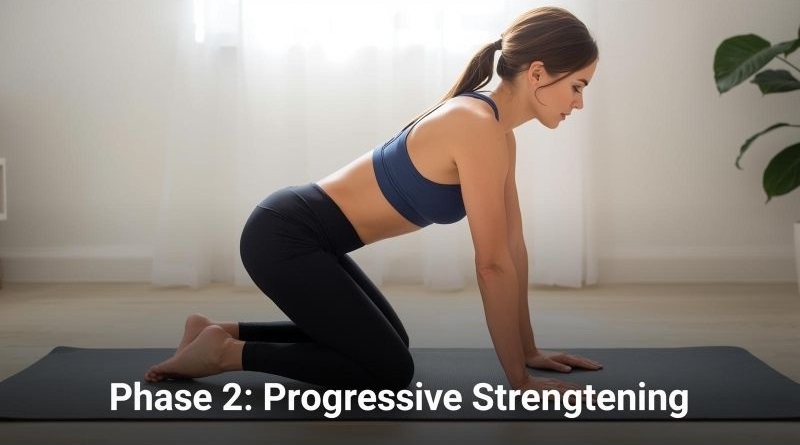
Woman on hands and knees showing proper quadruped position for Phase 2 postpartum core strengthening
Phase 2 Exercises (Weeks 5-8): A Bit Harder
Once Phase 1 feels easy, move to these diastasis recti exercises.
Exercise 4: Quadruped (Hands and Knees Position)
Why: This strengthens your core while keeping it safe.
How to do it:
- First, get on your hands and knees
- Keep your spine neutral (don’t arch your back)
- Then, tighten your belly slightly
- Hold for 10 seconds
- Finally, release
Repeat: 10 times, once per day
Pro tip: This position is great because it doesn’t put pressure on your separated muscles like standing does.
Exercise 5: Glute Bridge (Butt Lift)
Why: This strengthens your glutes and back, which supports your core.
How to do it:
- First, lie on your back, knees bent, feet flat on ground
- Keep feet hip-width apart
- Then, squeeze your butt muscles
- Lift your hips up toward the ceiling
- Hold for 5 seconds
- Lower down slowly
- Finally, repeat
Repeat: 15 times, 2-3 times per week
Why this helps: Your back and butt muscles are like a team with your core. When they’re strong, your belly area heals better.
Exercise 6: Side-Lying Leg Lift
Why: This strengthens sides of core without stressing separated muscles.
How to do it:
- First, lie on your side with your bottom leg bent
- Keep top leg straight
- Then, lift top leg up slowly (about 12 inches)
- Lower slowly
- Do 10 lifts
- Finally, flip and repeat on other side
Repeat: 10-15 times per side, 2-3 times per week
Phase 3 Exercises (Weeks 9+): Building Strength
These diastasis recti exercises are for after your muscles are starting to come back together.
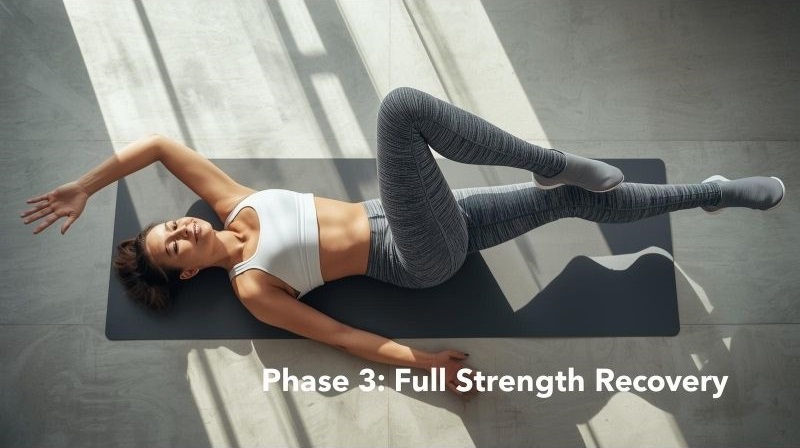
Exercise 7: Dead Bug (Safer Alternative to Sit-ups)
Why: This strengthens your core without doing crunches (which are bad for diastasis recti).
How to do it:
- First, lie on your back
- Then, lift your arms straight up toward ceiling
- Lift your legs up (knees bent at 90 degrees, like sitting in a chair)
- Next, lower your right arm overhead while straightening right leg
- Bring them back up
- Do the same with left side
- Finally, keep alternating
Repeat: 10 times per side, 1-2 times per week
This is better than sit-ups because: It doesn’t create pressure on your healing muscles.
Exercise 8: Plank Position (Against a Wall)
Why: This builds serious core strength.
How to do it:
- First, stand facing a wall
- Then, put your hands on the wall at shoulder height
- Walk your feet back
- Your body should be at an angle
- Next, tighten your belly
- Hold for 10-30 seconds
- Finally, rest and repeat
Repeat: 5-10 times, 2-3 times per week
Why against a wall: It’s easier than a floor plank, so it’s safer while healing.
What NOT to Do
Avoid these exercises while you’re healing:
- ❌ Traditional sit-ups – Creates pressure that’s bad for separation
- ❌ Full crunches – Same problem
- ❌ Heavy lifting – Too much pressure too soon
- ❌ Running – Wait until muscles are together
- ❌ Intense HIIT workouts – Too much pressure on core
When can you do these? Ask your doctor. Usually after 3-4 months of proper diastasis recti exercises.
Nutrition Helps Too
In addition to exercises, your muscles need fuel to heal. Eat:
- Protein: Chicken, eggs, beans, fish (helps rebuild muscle)
- Vitamin C: Oranges, berries, broccoli (helps with healing)
- Water: Drink lots! (helps your whole body heal)
Fun fact: Women who eat enough protein recover faster from diastasis recti.
Sleep and Rest Matter
Moreover, your body heals while you sleep. Try to:
- Sleep 7-9 hours (yes, even with a newborn!)
- Nap when baby naps (don’t just clean!)
- Rest between exercises (don’t do exercises every day)
Remember, recovery is part of healing.
When to See a Doctor
See your doctor if:
- You have pain in your belly area
- The gap is getting bigger, not smaller
- You feel bulging that doesn’t go away
- You have trouble with bladder or bowel control
- You’re not improving after 3 months of diastasis recti exercises
These might mean you need physical therapy or specialized help.
Common Questions About Diastasis Recti
Q: Can I breastfeed while doing these exercises?
A: Yes! Breastfeeding doesn’t affect these diastasis recti exercises.
Q: How fast will my belly close up?
A: Everyone’s different. However, with consistent diastasis recti exercises, most women see improvement in 6-12 weeks. Some take longer.
Q: Will I ever look normal again?
A: In most cases, yes! The gap closes. You might have a bit of loose skin (that’s normal after pregnancy), but your muscles will come together.
Q: Can I exercise if I had a C-section?
A: Yes, but wait longer (8-12 weeks). Your body had major surgery. Start with Phase 1 diastasis recti exercises and progress slowly.
Q: What if I still have a gap after 6 months?
A: Talk to your doctor. You might need physical therapy from a specialist who knows about postpartum recovery.
Your Action Plan
Week 1-2:
- Check with your doctor (get the okay to exercise)
- Do Phase 1 diastasis recti exercises daily
- Notice how your body feels
Week 3-4:
- Keep doing Phase 1
- Start adding Phase 2 exercises
- Check your gap (did it get smaller?)
Week 5-8:
- Focus on Phase 2 diastasis recti exercises
- Mix in some Phase 3 exercises
- Tell your doctor if you’re improving
Week 9+:
- Move to Phase 3 diastasis recti exercises
- Consider getting back to regular fitness (with caution)
- Keep doing core exercises forever (they prevent problems)
Related Articles to Help You
If you’re interested in postpartum recovery, you might also like:
📌 Postpartum Fitness Timeline: Safe Return to Exercise – This article covers the full timeline of what you can do after having a baby, week by week.
📌 Postpartum Weight Loss Tips: Exercise + Nutrition for Moms – Once your core is healing, this article helps you safely lose the baby weight.
📌 Low-Impact Senior Workouts: Joint-Friendly Fitness – Not for you now, but great reference for low-impact exercises in general.
The Bottom Line
Diastasis recti is common. It’s fixable. Be patient.
Start with Phase 1 diastasis recti exercises. Do them consistently. Give your body time. Most women close the gap in 3-6 months with these exercises.
If you’re not improving or worried, talk to your doctor.
You got this! Your body is stronger than you think. ✨
Key Takeaways
- ✅ Diastasis recti = separated belly muscles (happens in most pregnancies)
- ✅ Check yourself using the finger test
- ✅ Start with Phase 1 diastasis recti exercises (they’re safest)
- ✅ Progress slowly to Phase 2, then Phase 3
- ✅ Avoid sit-ups – they make it worse
- ✅ Be patient – healing takes time
- ✅ See a doctor if you’re worried
Do you have questions about your postpartum recovery? Drop them in the comments below! Also, share this with other new moms – they might find it helpful. 💪